Thomas Morton was a businessman, not a religious refugee. But he sailed to the Plymouth Colony in 1624 to settle in the New World. Morton didn't see eye-to-eye with the strict, isolationist Puritans, and they saw him as "a dandy and a playboy.” It wasn't long before Morton left Plymouth to start his own community, with like-minded individuals and Native Americans who enjoyed fun, freedom, and fellowship that they couldn't get with the Puritans.
The Puritan authorities didn’t see Merrymount as a free-wheeling annoyance; they saw an existential threat. The problem wasn’t only that Morton was taking goods and commerce away from Plymouth, but that he was giving that business to the Native Americans, including trading guns to the Algonquins. With Plymouth’s monopoly dissolved and its perceived enemies armed, Morton had perhaps done more than anyone else to undermine the Puritan project in Massachusetts. Worse yet, in the words of Plymouth’s governor William Bradford, Morton condoned “dancing and frisking together” with the Native Americans—activities that were banned even without Native American participation. It was basically an early colonial version of Footloose. Governor Bradford nicknamed Morton the “Lord of Misrule,” and it’s not hard to imagine him wearing that title like a crown.
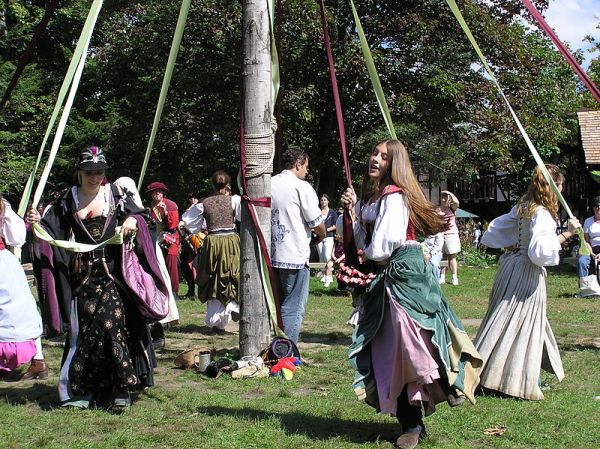
There could be no greater symbol of such misrule than Morton’s maypole. Reaching 80 feet into the air, the structure conjured all the vile, virile vices of Merry England that the Puritans had hoped to leave behind.
The Puritans still held power, so they invaded Merrymount, arrested Morton, and banished him from the colonies. Morton retaliated by writing a three-volume book, New English Canaan, telling exactly what he thought of the Puritans. It was a scandalous expose that Puritans found slanderous. Read about Morton and his book at Atlas Obscura.
(Unrelated image credit: KenL)